
When people compare Agile and Waterfall, the explanations are often either too academic or too oversimplified. In practice, the differences show up in how teams handle change, risk, and communication not just in how they organize tasks.
Here’s a clearer, more grounded look at both approaches.
Waterfall: Structured, Predictable If the Inputs Are Stable

Waterfall follows a linear path: define requirements, design the system, implement it, test it, then release. Each phase is meant to be completed before moving forward.
This works well when the problem is well understood from the beginning. For example, systems with strict regulatory requirements or projects where the scope is unlikely to change.
Strengths:
- Clear milestones and documentation
- Easier to estimate timelines and budgets upfront
- Works well in environments where change is costly
Limitations:
- Changes late in the process are expensive
- Testing happens after most decisions are already locked in
- Feedback from users comes relatively late
In real projects, the biggest risk is assuming early requirements will hold. If they don't, the model becomes rigid very quickly.
Agile: Iterative, Adaptive, and Feedback-Driven
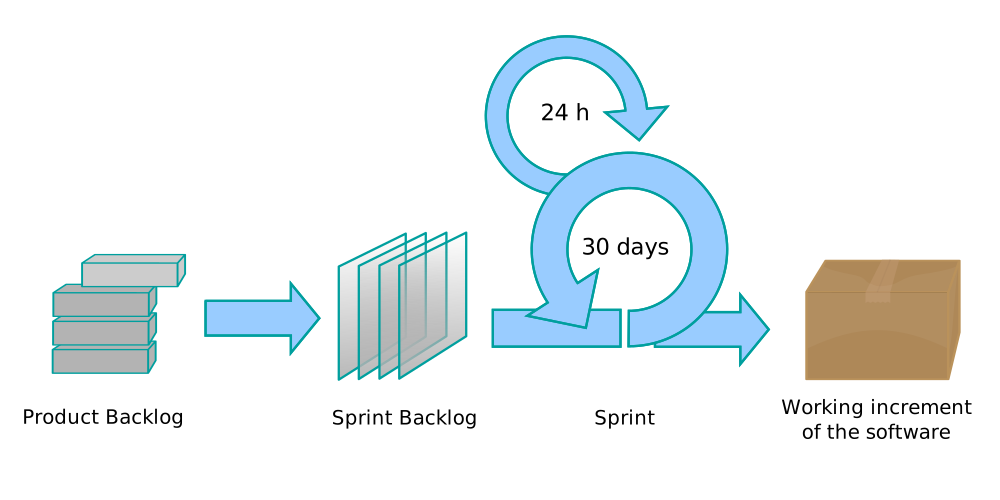
Agile takes a different approach. Instead of delivering everything at once, teams work in short cycles (often called sprints), producing small increments of working software.
Each iteration includes planning, development, testing, and review. Feedback is built into the process.
Strengths:
- Adapts well to changing requirements
- Continuous testing reduces late stage surprises
- Regular user feedback improves alignment with actual needs
Limitations:
- Requires strong coordination and communication
- Estimates are less fixed, especially early on
- Without discipline, structure can degrade
Agile tends to perform well in environments where requirements evolve or aren't fully known at the start which is common in modern software projects.
Key Differences That Actually Matter
| Area | Agile | Waterfall |
|---|---|---|
| Planning | Incremental | Upfront |
| Change Management | Expected and accommodated | Controlled and often limited |
| Delivery | Continuous (in increments) | Single release at the end |
| Testing | Ongoing | Late-stage |
| User Involvement | Continuous | Primarily at start and end |
The core difference is how each approach handles uncertainty. Agile assumes change is inevitable (Thanos reference) and builds around that. Waterfall assumes change is minimal and tries to reduce it early.
Choosing Between Them
The choice isn't about which is "better" in general it's about fitting it in the right project.
Waterfall makes sense when:
- Requirements are clearly defined and stable
- Compliance or documentation is a major constraint
- The cost of change is high
Agile is more suitable when:
- Requirements are evolving
- Early and frequent feedback is valuable
- Speed of iteration matters
In practice, many teams use a mix: some upfront planning for structure, combined with iterative delivery for flexibility.
Final Thoughts
The methodology itself won't determine success. What matters more is how well the team understands the problem, communicates, and adapts when things don't go as expected.
Agile and Waterfall are just tools. Used appropriately, both can work. Used poorly, neither will.
Sources & Further Reading
- Agile Manifesto – https://agilemanifesto.org/
- Atlassian (Team behind JIRA) Agile Guide – https://www.atlassian.com/agile
- Project Management Institute – https://www.pmi.org/